Migliori Casino OnlineMeilleur Casino En Ligne FranceCrypto CasinoCrypto CasinoNuovi Casino Non Aams

Skip to Content

WINTER NAMM 2014: Two Notes Torpedo Studio

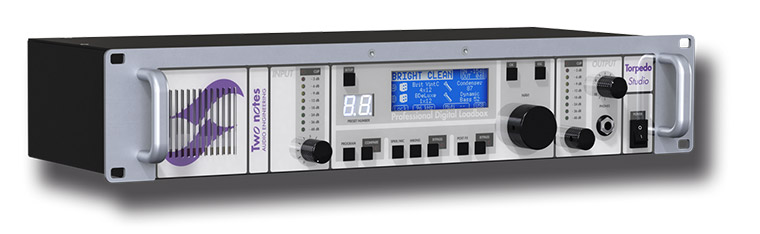
two notes Torpedo STUDIO
Two Notes Audio Engineering have updated their very popular load box, speaker simulator and studio effects unit, the VB-101 with a new model due later this year called the Torpedo Studio. Its new features notably include a new loadbox with increased admissible power, a switchable impedance (4, 8, or 16 Ohms), and the possibility to choose between resistive and reactive loadbox. Its new, enhanced design also makes it a much lighter successor to VB-101.

More details to come but keep an eye on the Two Notes website here.

Click here to comment

WINTER NAMM 2014: New Scott Ian Signature Amp from Randall - Ultimate Nullifier

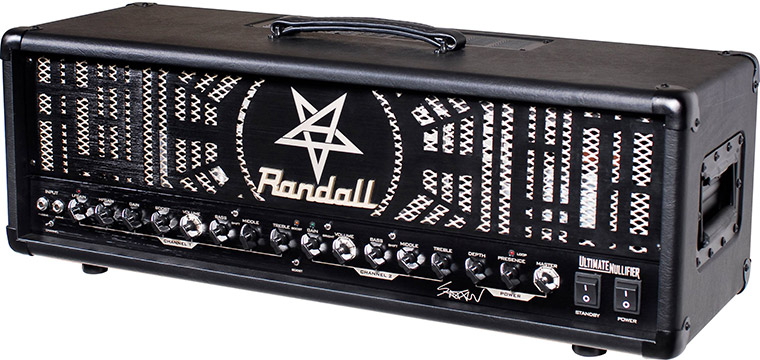
randall ultimate nullifier scott ian
Anthrax’s Scott Ian has a new signature amp from Randall launching at Winter NAMM 2014 called Ultimate Nullifier (UN120). I actually liked the idea of Scott Ian’s previous signature amp called the RM100SI which used the MTS Modules system licensed from Egnater so that you can switch the preamp modules in and out for each channel but I guess that system has been discontinued since Mike Fortin stepped in as lead amp designer. Regardless I’m sure this amp will be an absolute beast.

The Ultimate Nullifier is a 120 Watt all tube head with 2 channels and 4 modes. The preamp is powered by 6 12AX7’s and the power amp by 4 6L6’s. It has a tube driven series/parallel effects loop that is foot switchable. It also has active and passive inputs, high and low frequency gain controls, variable boost and full EQ for both channels, presence/depth power amp voicing, push/pull bias controls and some heavy duty appointments including the metal front and rear grills plus additional side handles.

There is also a 4×12 Scott Ian signature cabinet (SI412-GB) loaded with 4 Celestion greenbacks.

http://www.randallamplifiers.com/

Click here to comment

WINTER NAMM 2014: Strandberg Per Nilsson Signature Model - Singularity

strandberg per nilsson singularity
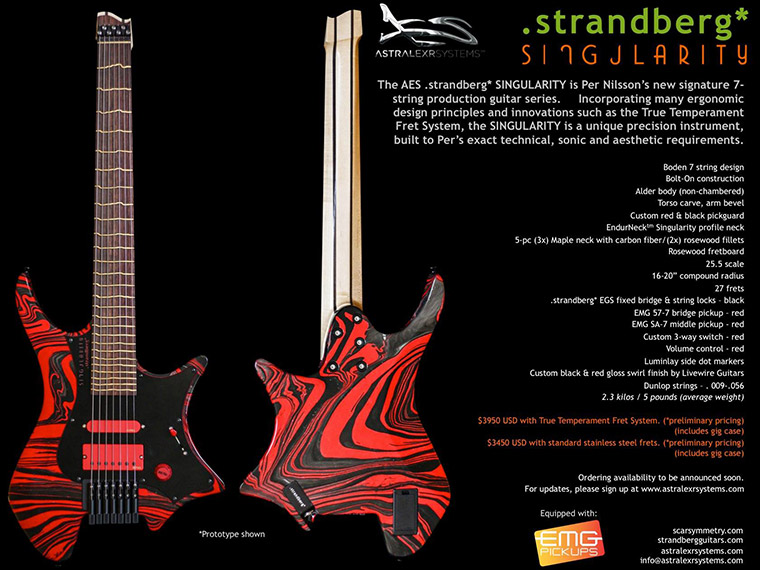
Astral EXR Systems have announced via their Facebook page the new Per Nilsson signature Strandberg called the Singularity, it’s a 7 string with true temperament frets with a swirl finish!

As you can see from the image above the body is based on a Boden 7 model which I assume will be produced by Washburn as per their recent production collaboration. Visually aside from the swirl finish, a first for Strandberg as far as I know, it also has a pickguard which I don’t believe I’ve seen to date either. Also you will notice the squiggly frets known as the True Temperament Fret system which means each fret is perfectly in tune, oh and there are 27 of them on the 25.5″ scale Rosewood fretboard which features a 16-20″ compound fretboard radius. The pickups are courtesy of EMG, a 57-7 in the bridge position and an SA-7 in the middle position. The guitar also features Luminlay side dot markers to glow in the dark and is available for $3950 with the True Temperament fret system or $3450 without.

Ordering availability to be announced soon so keep an eye on their facebook page or the website - http://astralexrsystems.com/.

Click here to comment

WINTER NAMM 2014: Periphery’s Jake Bowen signings and special announcement

Well this could be the news that a lot of people have been waiting for. We already know about Jake Bowen’s new signature DiMarzio Titan pickups so that only leaves one thing, the signature Ibanez based on the LACS model he has been using in Periphery for a while seen in the video below:

Click here to comment

WINTER NAMM 2014: Mad Professor Old School 21RT

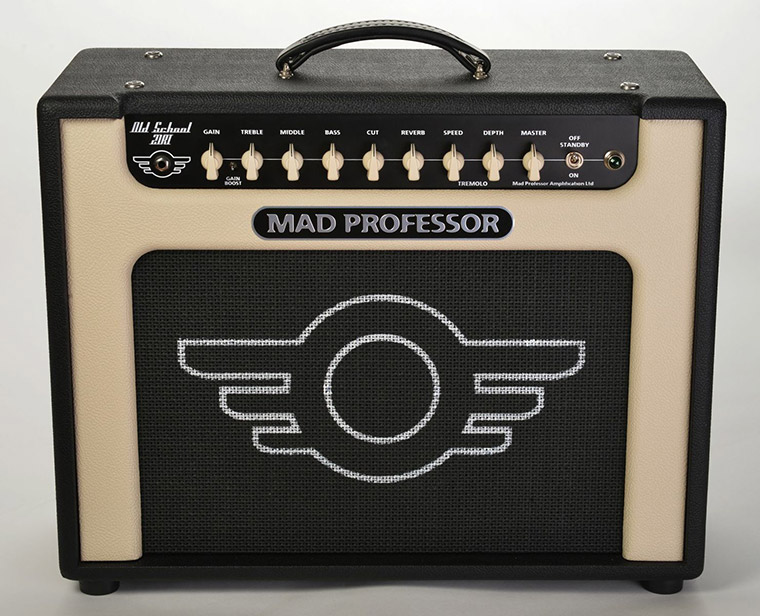
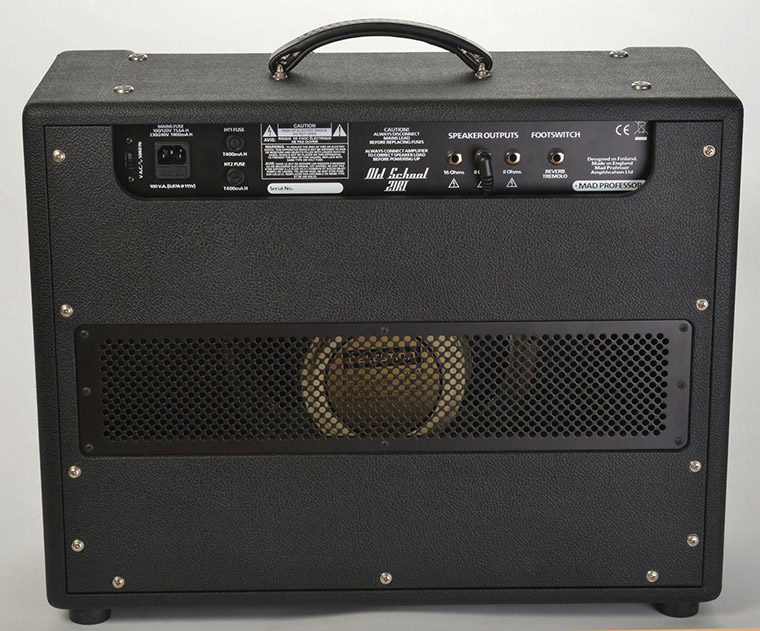
Now here’s an amp that covers a lot of ground from pristine cleans to creamy thick overdrive tones, the OS21 RT is Mad Professor’s 21 Watt amp powered by 4 12AX7 preamp tubes and 2 6V6 power tubes now with built in Reverb and Tremolo hence the addition of RT to the name. The Old School 21RT comes in either a head or a 1×12″ Combo and is a single channel amplifier designed to be reactive to your guitar volume. The amp is also designed to take pedals well, you would hope it would coming from a pedal manufacturer! To hear all of the tones you can get from this versatile low watter check out yet another great demo by Marko Karhu.

Click here to comment

WINTER NAMM 2014: Mad Professor Announce The Simble Overdrive Pedal

mad professor simble
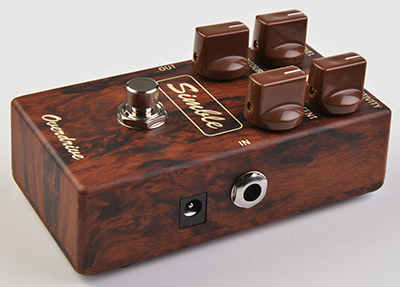
The new Simble Overdrive pedal from Mad Professor is designed by amp wizard Lassi Ukkonen who has serviced, fine-tuned and modified the best amplifiers in the world and has built into this pedal what the best amplifiers are all about: natural organic tone, touch sensitivity and sweet tube-like compression. This natural sounding pedal works as a clean boost, ”on the edge” crunch, or a sweet singing overdrive, always retaining the tone of your prized guitar.

CONTROLS

  • SENSITIVITY: Amount of distortion and compression
  • LEVEL: Output level
  • ACCENT: Pick attack and brightness
  • CONTOUR: Brightness of the output

Available April 2014.

Check out this great demo from Marko Karhu:

Click here to comment

WINTER NAMM 2014: New Pedals From Randall Amplifiers

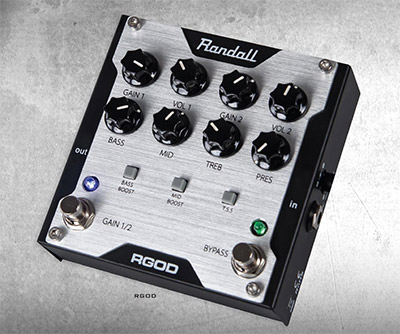
Randall have posted a few pedals that they will be releasing at Winter NAMM 2014 including the RGOD pictured below which is a 2 channel FET preamp pedal with Gain 1 & 2 as well as Vol 1 & 2 controls, a shared EQ, Bass boost, Mid Boost and Tone Stack Shift switches, runs on 9-15v power supply and it is true bypass.
randall rgod

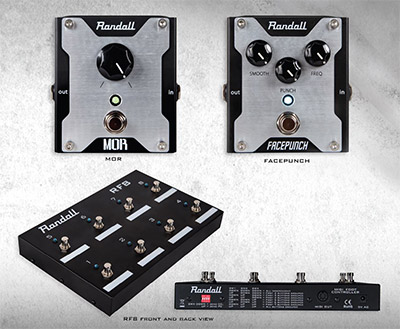
Also in the lineup are the MOR, which is an aggresive clean boost controlled by a single knob which again is true bypass and runs on a 9v battery or power supply. Then there is the subtly titled FACEPUNCH, an overdrive pedal with Smooth, Punch & Freq controls. True bypass, 9v battery or external power supply. And finally the RF8 which is an 8 button universal MIDI footswitch.
randall_pedals

If you are heading to Winter NAMM make sure you stop by the Randall Booth otherwise keep an eye on the Randall Amplifiers Facebook page and website for more details.

Click here to comment

5 Steps Toward Guitar Success

byline picby Pappy

Inspired by Rocksmith 2014, a few of my friends have expressed interest in learning guitar. They plan on getting the game and… what’s that other thing they need? Oh yeah! A guitar! They need a guitar. One said he was going to the pawn shops to look for the cheapest (but best) guitar he could find. One said he was going to Target.

I asked if the pawn shop guy was going to bring a guitar playing friend and he said no, he was just going to find the cheapest (but best) guitar he could find. But, I countered, if you have no experience how can you find anything but the cheapest guitar? If you have no concept of what makes quality “quality,” then how can you spot it?

And Target? Really? Come on! That’s just crazy talk.

It’s obvious that the main goal these people have in mind is getting something cheap. The problem is that cheap is EXACTLY what they’ll get.

Look, it’s not that I don’t understand: playing guitar is constantly reported to be a difficult pursuit and new players are jumping into a hobby with no reference point - no base that they already have upon which to build. This is a risky proposition. Good intentions aside, what guarantee do you have that you will pick the skill up with minimum difficulty or even enjoy the progress (regardless of challenge)? It makes total sense that, put in a situation like this, you’ll want to mitigate your financial risks and spend as little as possible so if it turns out to be wrong for you, you aren’t out TOO much money.

You just can’t argue with that logic.

Well… I can.

If you go about investing in a new hobby like this, with the seed of doubt not only planted, but growing enough for you to think that there’s actually a pretty good chance that this is a doomed pursuit, YOU’VE ALREADY QUIT. You’ll go through the motions, you’ll learn the opening riff of “Come As You Are,” you’ll hurt your fingers and say that you’ll give yourself a couple of days to recover. These couple of days turns out to be a week, then two weeks, and then something needs to be moved in your bedroom or living room and your guitar is relocated to a closet or under your bed. Months later someone will ask you if you’re still playing guitar and you’ll say “nah. It wasn’t for me.” Failing was easy - way easier than it should have been - because you PLANNED to fail, not to succeed.

It doesn’t help that cheap guitars - really cheap guitars - suck. The action (distance from frets to strings) is usually high , which makes you have to expend more effort (causing more pain to sensitive fingers) pushing them down. When I was about six or seven years old, I told my mom I wanted to learn guitar and she let me use her ancient Silvertone acoustic with 30+ year-old strings, a radically bowed neck, and action measured in inches, not millimeters. Playing was torture and when I quit, everyone thought it was because I didn’t like guitar. The thought that perhaps it was because I was trying to play on what could have been a torture device never crossed their minds. They also often sound like garbage, don’t look all that great, and are uninspiring. If you aren’t inspired by the feel, sound, or look of your guitar, what is going to make you WANT to pick it up when you’re sitting on your couch watching TV?

With this in mind, I offer an alternative approach to the first guitar purchase, as well as several other tips to help give you an edge toward guitar success:

1) Buy bigger. You don’t have to spend a ridiculous amount of money - especially on your first guitar - to get a good guitar, but the goal here is to spend an amount of money that you would be upset to lose. That way whenever it catches your eye you’ll say to yourself you really should play it (after all, you spent $XXX.XX on it!). When you don’t play it, it should sting knowing that the money - your hard-earned money - is just WASTING away somewhere in the house.

Price alone isn’t the only thing you should be looking for, though. Here are some other tips:

2) Buy an electric guitar. Not an acoustic guitar, not an acoustic/electric guitar, purchase a full-blown electric guitar. The common myth is that everyone should start out on an acoustic “to build finger strength,” and to make playing an electric guitar so much easier. The people who push this myth forward have a name: buttholes. Why on earth would anyone start a brand new student on a guitar that is admittedly more difficult to play? Say a guy enters a gym for the first time, his arms spaghetti noodles hanging limp at his sides. Would you say “We’ll start you out bench-pressing 300 pounds. It totally makes sense because later on whenever you lift twenty pounds, it will be SO much easier!” No! You work UP to things, not DOWN to them. You should start out on the easiest guitar to play as possible (an electric guitar). The action is lower, the strings are thinner, the guitars are more comfortable for playing in a variety of situations, and if you ever want to play acoustic they’re always out there. For later.

3) Buy a guitar that you think looks good. if it looks good, you’re going to want to play it. The more you play it, the more comfortable you’ll get with it, the better player you’ll become and the more satisfied you’ll be with your progress. Don’t feel bad if you find yourself wanting to rock out in front of a mirror to see your cool guitar being played either, regardless of your age. It’s natural (and fun) and the whole point is to have fun here.

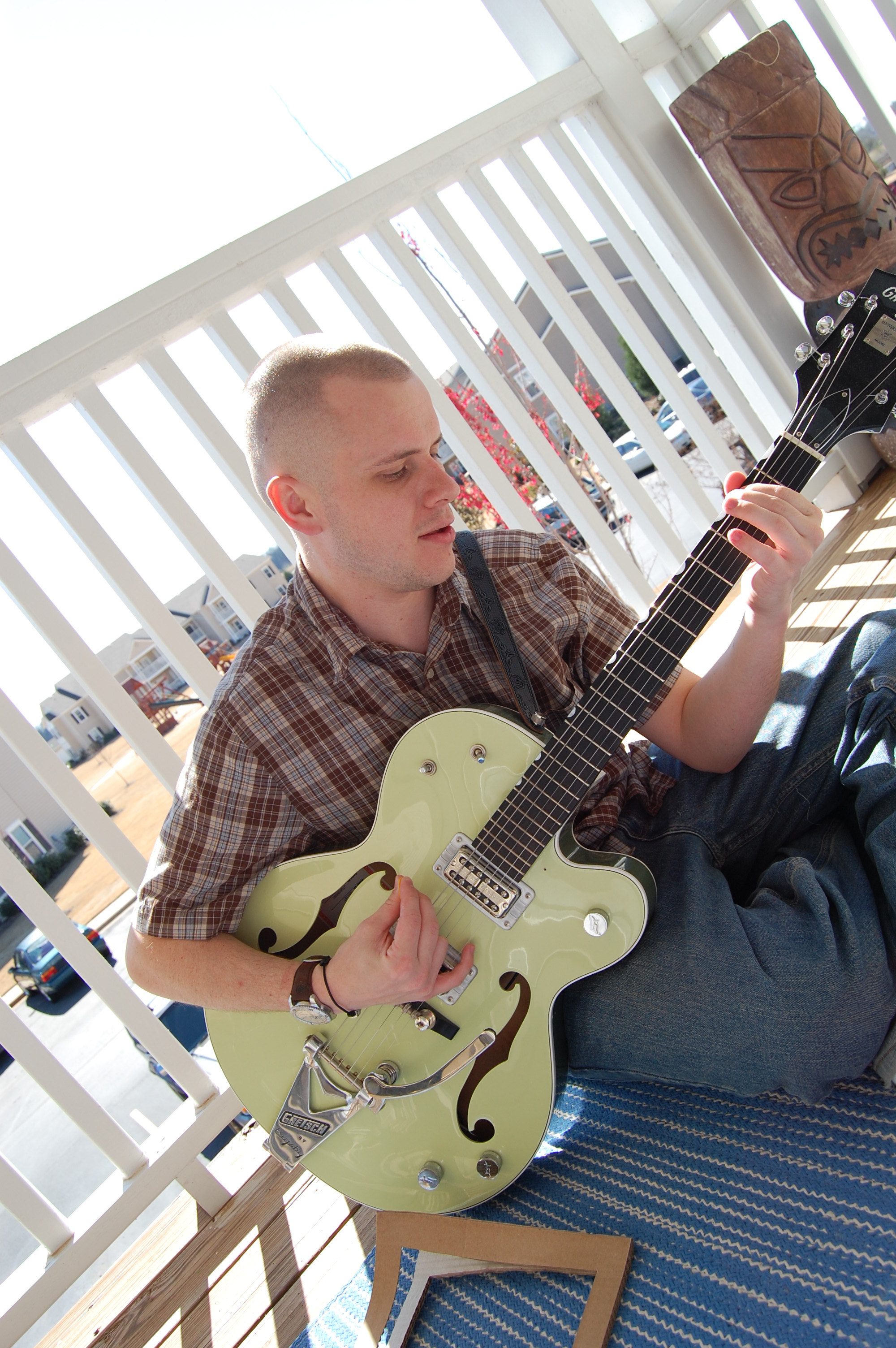
4) Try to minimize the amount of moving parts. “Tremolos,” (incorrectly named vibratos), springs, a ton of knobs or switches, and locking nuts are all things that require extra attention and add time and hassle keeping you from playing guitar RIGHT NOW. That’s why I recommend guitars with fixed bridges and no locking nuts. The Telecaster is probably among the most user-friendly guitars with minimal controls, not a lot of moving parts, and a general bullet-proof durability. It can take almost everything you can dish out. The Telecaster shape if offered from a variety of manufacturers, too, so don’t think that you’re locked into companies like Fender or Squier. If the Tele shape is for you, do some hunting and find the one that looks the most right for you.

5) Do not put it in a case. Ask any guitarist and almost all would say that your guitar will be safest in the case. You want to protect your investment. Why wouldn’t you want to keep your guitar in your case? Well, mainly because when it’s out of sight, it’s out of mind, and if playing isn’t a habit, you won’t play it. Instead, buy a guitar stand and keep your guitar in a frequented spot of your dwelling. I keep a guitar next to my couch - so close I can grab it without even getting up. My wife doesn’t really appreciate the aesthetic value, but I play so much more than I used to when my guitars were in my office or bedroom. All that time adds up and it makes me a better player.

Those tips again:

Buy bigger and plan on succeeding and continuing your guitar playing. Do NOT buy cheap, planning to minimize the financial loss WHEN you quit. That’s not a healthy mentality at all.

Buy an ELECTRIC guitar.

Buy what looks good to you. It should inspire you with its shape, color, or features.

Try to minimize the amount of moving parts. The less you have to maintain, the faster you can get to playing and the more you can focus on making music.

Put it in a stand in a frequently visited spot so it’s always near where you are. The more you see it, the more you’re reminded of it and your financial investment or the fun that have playing, the more likely you’ll reach out and grab it to play for a while. That time adds up.

These tips won’t guarantee guitar playing success for a beginner, but they’ll give you every opportunity to make you want to play and, like I said before, the more you want to play, the more you’ll play, and the more you’ll play, the better you’ll get and the more fun you’ll have as you progress on your journey learning the guitar.

Click here to comment

WINTER NAMM 2014: Michael Kelly Guitars Unveil New Tribute 50’s Guitar

  • Michael Kelly 50s
  • Michael Kelly 50s
  • Michael Kelly 50s

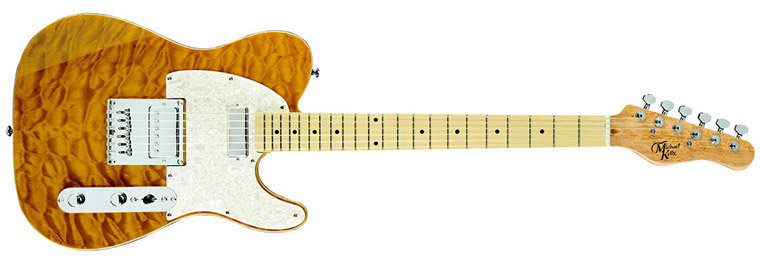
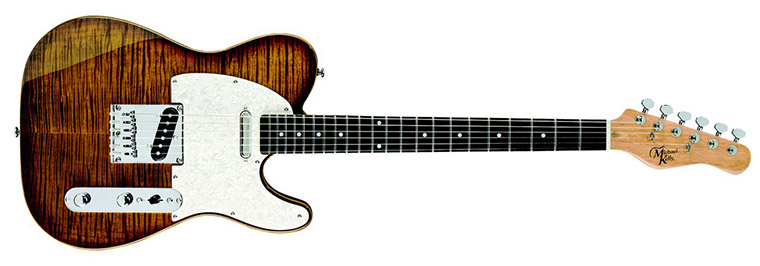
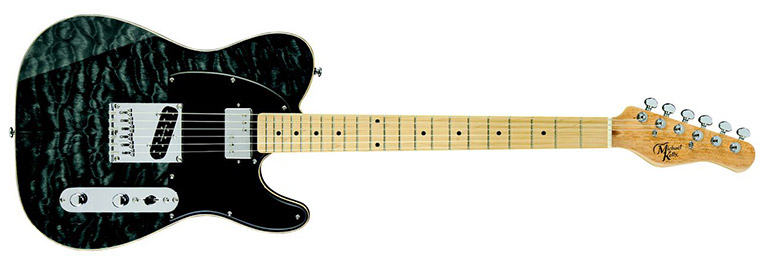
Michael Kelly Guitars have announced a new T type guitar to their product line called the 1950’s Series available in five distinct models. Following their unique “Boutique Within Reach” approach of producing instruments, Michael Kelly Guitars builds with the features, fit, finish and playability of those respected high end, low quantity builders but at key price points obtainable to the masses.

Press Release
The highlight of the series is the 1955 ($729). Besides being one of the first guitars under $1000 to have real flamed maple body binding, the guitar offers the unique pickup configuration with a Rockfield humbucker in the bridge and mini humbucker in the neck position. The swamp ash body with quilted maple top includes a white pickguard and chrome hardware. The maple neck features a six inline headstock and a compound 10.5” to 16.5” radius. Black wash and amber translucent finishes come with a maple fretboard and the caramel burst finish comes with a rosewood fretboard.

The 1952 ($449) is a basswood body with flamed maple top outfitted with dual humbuckers, chrome hardware, white body binding and no pickguard. The maple neck features a six inline headstock and 12” radius, maple fretboard. Available finishes are deep cherry red and natural gloss.

The 1953 ($580) is an alder body with flamed maple top outfitted with a stacked single coil pickup in the bridge and a tele-style pickup in the neck position, chrome hardware, alder body binding and a white pearl pickguard. The maple neck features a six inline headstock and 10.5” radius. The caramel burst and black vapor finishes come with a rosewood fretboard while the blue jean wash finish comes with a maple fretboard.

The 1954 ($580) is an alder body with quilted maple top outfitted with a Rockfield SWC humbucker in the bridge and tele-style pickup in the neck position, black hardware, white body binding and no pickguard. The maple neck features a six inline headstock and 10.5” to 16.5” compound radius, rosewood fretboard.

The flagship is the 1957 ($875). This guitar is also one of the first under $1000 to have real flamed maple body binding. The swamp ash body is topped with a quilted maple top, chrome hardware and a white pearl pickguard housing a Seymour Duncan Little ’59 in the bridge and a Rockfield humbucker in the neck position. The maple neck features a six inline headstock, a 10.5” radius and maple fretboard. Available finishes are black wash and amber translucent.

To learn more online, please visit www.michaelkellyguitars.com

Or visit NAMM booth #4772 in Hall C

Click here to comment

WINTER NAMM 2014: Keeley Electronics Announces New Pedals

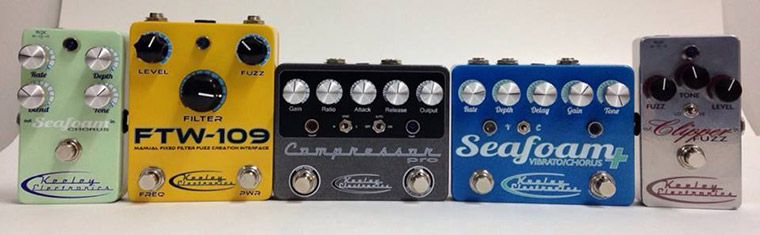
keeeley electronics namm 2014
Keeley Electronics have announced a whole slew of new pedals for Winter NAMM 2014. Pictured above are the Seafoam Chorus, FTW-109 Manual Fixed Fuzz Creation Interface, Compressor Pro, Seafoam+ Vibrato/Chorus and Clipper Fuzz. The Seafoam Chorus is already shipping but I believe only as of late December hence the inclusion in this lineup photo. The Red Dirt Overdrive was also included in one of Robert Keeley’s photos of pedals new for NAMM but that has also been available for a while.

There are no details about these pedals at this time but you can click here for high res photos and keep an eye on the Keeley Electronics facebook page for more announcements.

Click here to comment

Check these out